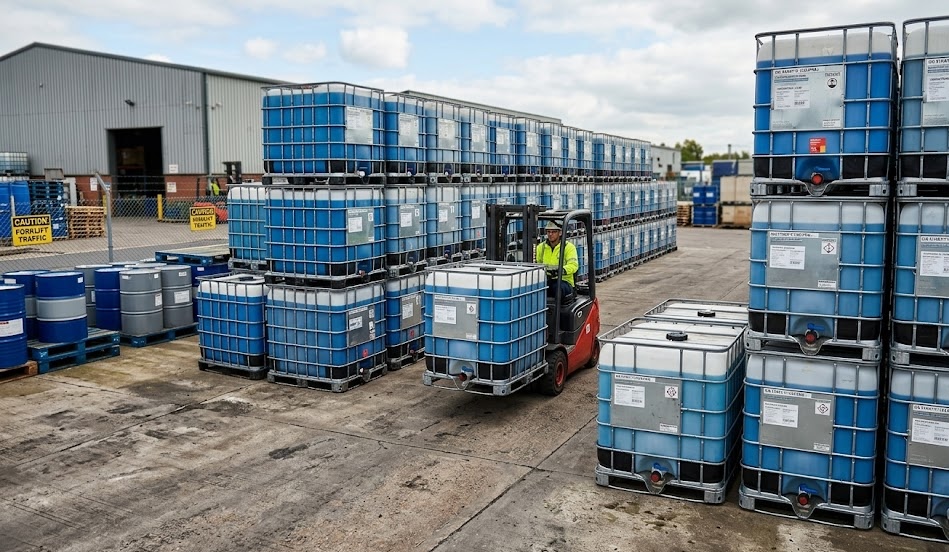
IBC Tank Recycling
Responsible recycling and disposal for end-of-life IBC containers. We ensure every material finds its highest-value second use.
Get a Free Quote
Tell us what you need and we'll get back to you within 24 hours.
Our Commitment to Zero Waste
A single IBC tank contains approximately 130 pounds of HDPE plastic, 50 pounds of galvanized steel, and a wooden or composite pallet. When these materials end up in a landfill, they take hundreds of years to decompose -- and they release microplastics and heavy metals into the soil and groundwater along the way. Our mission is simple: keep every IBC container out of the landfill and channel every component into the circular economy. We maintain a 98% material diversion rate, meaning virtually nothing we receive goes to waste.
Since opening our recycling program, we have processed over 12,000 IBC tanks and diverted more than 780 tons of material from landfills. Every tank we recycle saves approximately 53 kg of CO2 emissions compared to virgin material production, and conserves 1,200 gallons of water that would otherwise be consumed in the manufacturing of new plastics and metals. Our program is part of a broader commitment to making the IBC supply chain more sustainable for businesses across the Midwest.
Landfill Diversion Rate
CO2 Saved Per Tank
Water Saved Per Tank
Plastic Diverted Annually
Steel Recycled Annually
Trees Saved (pallets reuse)
The Recycling Process
Our seven-stage recycling process ensures full material accountability from intake to final disposition. Every tank is tracked through the system, and every kilogram of material is accounted for in our reporting. The process is designed to maximize the recovery rate of each material stream while maintaining strict environmental and safety standards.
Collection & Intake
Tanks arrive at our facility via drop-off or scheduled pickup. Each container is logged, photographed, and tagged with a unique tracking number so you can follow its journey through our system. We record the manufacturer, approximate age, and any visible labeling about previous contents. This data feeds into our material recovery reporting and ensures nothing is lost in the chain of custody.
Assessment & Sorting
Our team inspects every tank to determine its best path forward. Reusable tanks are routed to cleaning and reconditioning. End-of-life tanks are sorted by material type: HDPE plastic, galvanized steel, and wood or composite pallets. Tanks that previously held hazardous materials are flagged for special handling under our decontamination protocol before any disassembly begins.
Residue Neutralization
Before disassembly, every tank undergoes residue neutralization. Food-grade tanks are triple-rinsed with hot water. Chemical tanks receive a targeted neutralization treatment based on the previous contents -- acid residues are treated with alkaline solutions, and solvent residues are flushed with emulsifying agents. All rinse water is captured and treated in our on-site wastewater system before discharge.
Disassembly
Tanks that cannot be reused are carefully disassembled. The HDPE bottle is separated from the steel cage. Valves, gaskets, and fittings are removed. Every component is processed individually to maximize recovery rates. The process is manual rather than mechanized to prevent cross-contamination between material streams and to ensure the highest possible purity of each recycled output.
Material Processing
HDPE plastic is washed, shredded into flakes, and pelletized for reuse in manufacturing. Steel cages are baled and sent to regional metal recyclers. Wooden pallets are chipped for mulch or biomass energy production. Composite pallets are ground and sent to specialized recyclers. Even small components like gaskets and valve handles are sorted by polymer type and recycled separately.
Quality Control & Grading
Recycled HDPE flakes and pellets are tested for melt flow index, tensile strength, and contamination levels before being released to buyers. Each batch is assigned a quality grade that determines its end-use market -- high-grade regrind goes to container manufacturers, while lower-grade material is suitable for drainage pipe, plastic lumber, and other structural applications.
Documentation & Certificates
You receive a Certificate of Recycling for every batch processed. This documentation supports your sustainability reporting, ESG goals, and regulatory compliance requirements. Each certificate includes the date of processing, the weight of materials recovered by type, the downstream destination of each material, and a unique certificate number for your records.
Material Recovery Rates
We track recovery rates for every material stream that passes through our facility. The following table shows the average weight, recovery percentage, and current market value range for each component of a standard 275-gallon IBC tank.
| Material | Input (lbs) | Recovered (lbs) | Rate | Market Value |
|---|---|---|---|---|
| HDPE Plastic | 60 | 59.4 | 99.0% | $0.18-0.32/lb |
| Galvanized Steel | 45 | 45 | 100% | $0.08-0.12/lb |
| Wood (pallet) | 30 | 28.5 | 95.0% | $0.02-0.04/lb |
| Composite Pallet | 25 | 24.3 | 97.0% | $0.10-0.18/lb |
| PP/SS Fittings | 3 | 2.76 | 92.0% | $0.05-0.15/lb |
| Rubber Gaskets | 0.5 | 0.44 | 88.0% | $0.03-0.06/lb |
Market values shown reflect Midwest commodity pricing and fluctuate based on demand and material quality. Values current as of Q1 2026.
Where the Materials Go
Transparency is central to our recycling program. Here is exactly what happens to each component of an IBC tank once it enters our facility. We maintain relationships with verified downstream processors to ensure that recycled materials are actually reused, not downcycled or landfilled at a later stage.
HDPE Plastic Bottles
99% recoveredShredded and pelletized into recycled resin. Used to manufacture new containers, drainage pipe, plastic lumber, and industrial liners.
Avg. weight: ~60 lbs per tank
Steel Cages & Frames
100% recoveredBaled and shipped to regional steel mills for melting and reforming. Recycled steel becomes automotive parts, construction materials, and new industrial equipment.
Avg. weight: ~45 lbs per tank
Wooden Pallets
95% recoveredIntact pallets are repaired and reused. Damaged wood is chipped for landscaping mulch or processed into biomass fuel for energy recovery.
Avg. weight: ~30 lbs per tank
Composite / HDPE Pallets
97% recoveredGround into granules and sent to specialized plastic recyclers for re-processing into new pallets, park benches, and decking materials.
Avg. weight: ~25 lbs per tank
Valves & Fittings
92% recoveredFunctional components are cleaned and reused in reconditioning. Non-functional parts are sorted by material (polypropylene, stainless steel) and recycled accordingly.
Avg. weight: ~3 lbs per tank
Gaskets & Seals
88% recoveredEPDM and Viton gaskets are collected, baled, and sent to rubber recyclers where they are ground into crumb rubber for athletic surfaces, playground mats, and rubberized asphalt.
Avg. weight: ~0.5 lbs per tank
HDPE Plastic Regrind Market
Recycled HDPE from IBC tanks is a valuable commodity in the plastics market. The quality of the regrind determines its end-use application and market price. Here is how we grade and market the recycled HDPE from our facility. Businesses that generate large volumes of clean, single-source IBCs may qualify for material credit programs where the value of the recycled plastic offsets part of the recycling service fee.
Prime Regrind
Clean, single-color HDPE flakes from food-grade IBCs. Suitable for blow molding new containers, bottles, and packaging.
Industrial Regrind
Mixed-color HDPE flakes from industrial IBCs. Used for injection molding of non-cosmetic parts, crates, pallets, and pipe fittings.
Contaminated Regrind
HDPE flakes requiring additional washing. Sold to processors with advanced wash lines for use in drainage pipe, landscape edging, and lumber.
Off-Spec / Mixed Polymer
Mixed or degraded plastic material. Used for energy recovery or low-grade filler applications in construction materials.
Drop-Off & Pickup Options
We make recycling as convenient as possible. Whether you have one tank or a hundred, we have a solution that fits your schedule and budget.
Drop-Off at Our Facility
- Free drop-off during business hours (Mon-Fri 8am-5pm, Sat 9am-2pm)
- Located at 8520 G St, Omaha, NE 68127
- No appointment necessary for fewer than 10 tanks
- Forklift unloading provided at no charge
- Certificate of Recycling issued same day
- Tanks must be drained of contents before drop-off
- We accept tanks from any manufacturer or brand
- Photo ID required for chain-of-custody documentation
Scheduled Pickup Service
- Available throughout the Omaha metro and greater Midwest
- Minimum 5 tanks for free pickup within 50 miles
- Flexible scheduling to minimize disruption to your operations
- Our trucks, our labor -- you just point us to the tanks
- Certificate of Recycling mailed within 5 business days
- Pickups can be scheduled same-week for urgent needs
- We bring our own forklift or pallet jack as needed
- Evening and weekend pickups available by arrangement
How to Schedule a Pickup
Contact Us
Call (402) 810-5571 or email info@omahaibctanks.com with your address, tank count, and any info about previous contents.
Get Confirmed
We confirm the pickup date, time window, and any special requirements within 24 hours. No cost for standard recycling pickups of 5+ tanks within 50 miles.
Prepare Your Tanks
Drain residual contents (we can handle small residues). Stage tanks in an accessible area near a loading dock or driveway. No need to remove labels or fittings.
We Pick Up
Our crew arrives, loads the tanks, and leaves you with a signed manifest. Your Certificate of Recycling follows by email within 5 business days.
For large-volume recycling contracts or recurring pickup schedules, please contact us to discuss a custom arrangement. We serve manufacturers, distributors, farms, and municipalities across Nebraska, Iowa, Kansas, Missouri, and South Dakota.
Commercial Recycling Programs
Businesses that generate a steady stream of used IBC tanks benefit from our commercial recycling contracts. These programs provide predictable costs, priority scheduling, and detailed sustainability documentation that supports ESG reporting and regulatory compliance.
Manufacturing Contracts
For manufacturers generating 20+ empty IBCs per month, we offer dedicated recurring pickup contracts. Flat monthly rate, priority scheduling, and consolidated quarterly sustainability reports for your ESG program.
Min Volume
20+ tanks/month
Key Benefit
Flat monthly rate, priority pickup
Distribution & Warehouse
Distribution centers accumulate IBCs from multiple suppliers. We provide on-site roll-off containers for IBC collection and scheduled weekly or bi-weekly pickups, keeping your dock clear without disrupting operations.
Min Volume
10+ tanks/week
Key Benefit
On-site roll-off, weekly pickup
Agricultural Programs
Farms and ag co-ops often accumulate IBCs from fertilizers, crop protection chemicals, and liquid feed supplements. We offer seasonal collection events and year-round drop-off at our facility for any quantity.
Min Volume
Any quantity
Key Benefit
Seasonal collection events
Municipal & Government
City, county, and state agencies can partner with us for responsible disposal of IBCs collected at hazardous waste drop-off events, public works yards, and water treatment facilities. Full compliance documentation for public records.
Min Volume
Any quantity
Key Benefit
Full government compliance docs
Industrial Waste Handling by Category
Different previous contents require different recycling approaches. Here is how we handle the most common categories of industrial IBC waste. If your tanks held something not listed here, contact us with the product name or SDS and we will advise on the appropriate handling protocol.
| Category | Handling Protocol | Hazard Level |
|---|---|---|
| Food & Beverage Residue | Triple-rinse and biological treatment of wash water. HDPE bottles with food residue are washed before shredding to prevent contamination of the recycled resin stream. | Non-hazardous |
| Agricultural Chemicals | Triple-rinse per EPA container rinsing guidelines (40 CFR 156.156). Rinse water captured and disposed through licensed hazardous waste contractor. Bottles shredded and recycled after decontamination verification. | Variable (check SDS) |
| Industrial Solvents | Solvent residues are drained and collected for fuel blending or solvent reclamation. Bottles are flushed with emulsifying agents, tested for residual contamination, and recycled if clean or disposed as hazardous waste if not. | Hazardous (RCRA regulated) |
| Petroleum Products | Oil and fuel residues are drained and sent to licensed oil recyclers. Bottles are processed through our hot-wash decontamination line. Steel cages are degreased before baling. | Non-hazardous to hazardous |
| Paints & Coatings | Latex paint residues are dried and landfilled as solid waste (non-hazardous). Solvent-based paint residues are managed as hazardous waste. Bottles are scraped, washed, and tested before recycling. | Variable |
| Cleaning Chemicals | Soap, detergent, and sanitizer residues are flushed with water and treated in our wastewater system. These are among the easiest IBCs to recycle due to the self-cleaning properties of the residues. | Generally non-hazardous |
Certifications & Compliance
IBC tank disposal is subject to federal and state environmental regulations. Improper disposal can result in fines, environmental contamination, and legal liability. When you recycle through Omaha IBC Tanks, you can be confident that every container is handled in full compliance with applicable regulations. Our facility holds the following certifications and licenses.
R2 Certified Recycler
Our recycling operations follow the R2 (Responsible Recycling) standard, ensuring that all materials are processed through verified downstream channels and that no hazardous materials are exported to developing nations.
ISO 14001 Aligned
Our environmental management system is aligned with ISO 14001:2015 standards. We maintain documented procedures for waste minimization, pollution prevention, and continuous improvement in our recycling operations.
Nebraska DEE Licensed
Fully licensed by the Nebraska Department of Environment and Energy (DEE) as a solid waste processing facility. License renewed annually with on-site inspection and compliance verification.
EPA Compliant
All processing meets EPA guidelines for HDPE plastic recycling and hazardous residue management under RCRA (Resource Conservation and Recovery Act). Waste manifests maintained for all hazmat-contaminated units.
DOT Compliant
Tanks that previously held hazardous materials are handled in accordance with DOT shipping and disposal requirements under 49 CFR. Hazmat-certified personnel manage all regulated containers.
ISRI Member
Member of the Institute of Scrap Recycling Industries (ISRI), the industry body that sets standards for scrap processing, safety, and environmental stewardship in the recycling sector.
Why Recycling Matters
Reduce Landfill Burden
An IBC tank takes up roughly 48 cubic feet of landfill space. With millions of IBCs in circulation across the United States, proper recycling prevents massive volumes of industrial waste from entering municipal landfills. Every IBC we recycle is one fewer container leaching chemicals into the ground.
Conserve Natural Resources
Recycling one HDPE bottle saves approximately 1,200 gallons of water and 340 kWh of energy compared to producing virgin plastic from petroleum feedstock. Recycled steel saves 74% of the energy needed for primary production. These savings compound with every tank we process.
Protect Local Ecosystems
Omaha sits at the confluence of the Missouri and Platte Rivers. Improperly discarded containers can leach chemicals into groundwater and waterways. Responsible recycling protects the ecosystems that our community depends on for drinking water, agriculture, and recreation.
Support the Circular Economy
Every pound of recycled HDPE displaces a pound of virgin plastic production. Recycled steel re-enters the manufacturing stream at a fraction of the energy cost. By recycling your IBCs, you are actively contributing to a circular economy where materials are perpetually reused rather than discarded.
Meet Corporate Sustainability Goals
Recycling documentation from our program feeds directly into ESG reporting frameworks. Our Certificates of Recycling include material weights, CO2 offset calculations, and downstream processor details -- everything your sustainability team needs for annual reports and investor disclosures.
Reduce Carbon Footprint
Manufacturing new HDPE from petroleum produces approximately 1.8 kg of CO2 per kilogram of plastic. Recycled HDPE produces roughly 0.5 kg -- a 72% reduction. For a typical 60-lb IBC bottle, that translates to about 53 kg of CO2 avoided per tank recycled through our program.
Recycling Pricing
In many cases, recycling your IBC tanks is free or even generates a credit. Pricing depends on the condition of the tanks and whether they require hazardous material handling.
Large-volume generators (20+ tanks/month) may qualify for material credit programs where the scrap value of the HDPE and steel offsets or exceeds the recycling service fee. Contact us to discuss options.
Related Services
Not every tank needs to be recycled. Many containers still have life left in them. Explore our other services to find the best option for your IBC tanks.