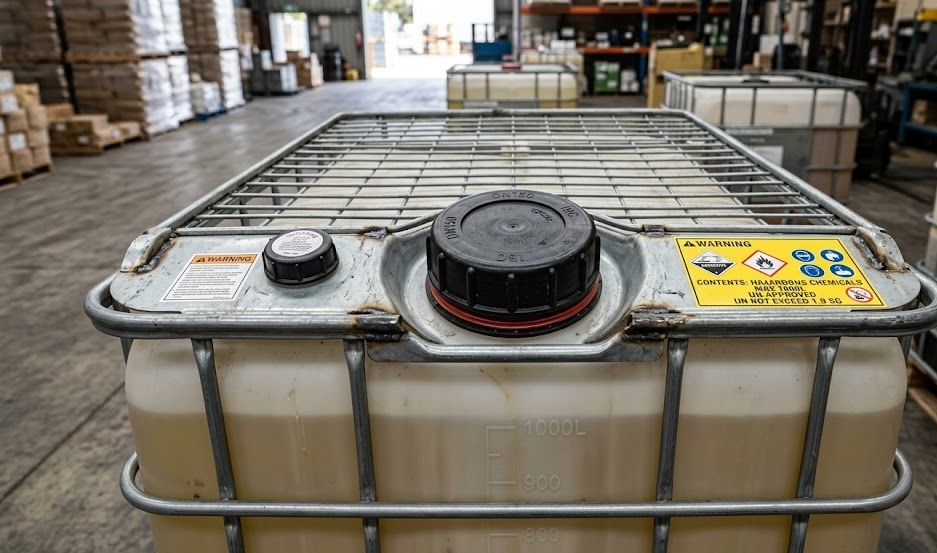
IBC Tank Size Guide
The most comprehensive intermediate bulk container dimension and specification reference available. Compare every IBC tote size side by side.
Get a Free Quote
Tell us what you need and we'll get back to you within 24 hours.
Understanding IBC Tank Sizes
Intermediate Bulk Containers (IBCs) come in three primary sizes used across North America and globally. The 275-gallon (1,040-liter) tote is the industry standard, accounting for roughly 80% of all IBC tanks in circulation. The 330-gallon (1,250-liter) variant provides maximum capacity on a standard pallet footprint, while the 110-gallon (415-liter) compact IBC serves applications where space or weight limits are a concern.
This guide covers every specification you need to make an informed purchasing decision -- external dimensions, internal volume, empty and filled weights, pallet compatibility, valve configurations, material composition, regulatory ratings, and stacking limits. Whether you are purchasing your first IBC or managing a fleet of thousands, you will find the data you need here.
275 Gallon IBC Tank (Standard)
The 275-gallon IBC is the workhorse of the liquid container industry. This is the size you will find on most loading docks, in most warehouses, and on most product data sheets when someone says “IBC tote.” It fits a standard 48″ x 40″ North American pallet footprint and is designed for maximum efficiency in shipping, storage, and dispensing.
| Specification | Imperial | Metric |
|---|---|---|
| Nominal Capacity | 275 US gallons | 1,040 liters |
| Actual Fill Capacity | 270 US gallons | 1,022 liters |
| External Dimensions (L x W x H) | 48″ x 40″ x 46″ | 1,200 x 1,000 x 1,168 mm |
| Internal Dimensions (L x W x H) | 45″ x 37.5″ x 42″ | 1,143 x 953 x 1,067 mm |
| Pallet Footprint | 48″ x 40″ | 1,200 x 1,000 mm |
| Pallet Height | 5.5″ | 140 mm |
| Overall Height (with pallet) | 53.5″ | 1,359 mm |
| Empty Weight (tare) | 130 - 145 lbs | 59 - 66 kg |
| Filled Weight (water) | 2,425 lbs | 1,100 kg |
| Maximum Gross Weight | 2,645 lbs | 1,200 kg |
| Top Fill Opening | 6″ (150 mm) screw cap | DN150 |
| Bottom Discharge Valve | 2″ butterfly valve | DN50 / S60x6 thread |
| Stacking Load (static) | Up to 2 high (filled) | 5,290 lbs / 2,400 kg |
Why 275 Gallon Is the Standard
- Fits perfectly on a standard North American GMA pallet (48″ x 40″)
- 20 units fit on a standard 53-foot trailer (two deep, two wide, five long)
- Meets DOT weight limits when filled with water-weight liquids
- Most widely available size for both new and used IBC totes
- Greatest selection of aftermarket fittings and adapters
- Compatible with virtually all IBC filling and dispensing equipment
330 Gallon IBC Tank (Large)
The 330-gallon IBC provides 20% more capacity than the standard 275-gallon while maintaining the same pallet footprint. The extra volume comes from increased height. This size is popular in the European market (where it maps directly to 1,250 liters) and is increasingly common in North America for applications where maximizing volume per pallet position is critical.
| Specification | Imperial | Metric |
|---|---|---|
| Nominal Capacity | 330 US gallons | 1,250 liters |
| Actual Fill Capacity | 325 US gallons | 1,230 liters |
| External Dimensions (L x W x H) | 48″ x 40″ x 53″ | 1,200 x 1,000 x 1,346 mm |
| Internal Dimensions (L x W x H) | 45″ x 37.5″ x 49″ | 1,143 x 953 x 1,245 mm |
| Pallet Footprint | 48″ x 40″ | 1,200 x 1,000 mm |
| Pallet Height | 5.5″ | 140 mm |
| Overall Height (with pallet) | 58.5″ | 1,486 mm |
| Empty Weight (tare) | 145 - 160 lbs | 66 - 73 kg |
| Filled Weight (water) | 2,915 lbs | 1,322 kg |
| Maximum Gross Weight | 3,086 lbs | 1,400 kg |
| Top Fill Opening | 6″ (150 mm) screw cap | DN150 |
| Bottom Discharge Valve | 2″ butterfly valve | DN50 / S60x6 thread |
| Stacking Load (static) | Up to 2 high (filled) | 6,172 lbs / 2,800 kg |
When to Choose the 330-Gallon IBC
- You need maximum volume per pallet position in your warehouse
- Shipping costs are calculated per container rather than per gallon
- Your facility has adequate vertical clearance (door heights above 60″)
- You are working with European suppliers or customers who ship in 1,250L IBCs
- Ideal for rain harvesting systems and large-volume water storage
110 Gallon IBC Tank (Compact)
The 110-gallon IBC is the smallest standard IBC size. Sometimes referred to as a “half tote” or “mini IBC,” it uses a smaller pallet footprint and is designed for applications where the full 275-gallon size is too large, too heavy, or physically will not fit. These are popular in food processing, pharmaceutical compounding, and small-batch chemical distribution.
| Specification | Imperial | Metric |
|---|---|---|
| Nominal Capacity | 110 US gallons | 415 liters |
| Actual Fill Capacity | 107 US gallons | 405 liters |
| External Dimensions (L x W x H) | 36″ x 36″ x 37″ | 914 x 914 x 940 mm |
| Internal Dimensions (L x W x H) | 33″ x 33″ x 33″ | 838 x 838 x 838 mm |
| Pallet Footprint | 36″ x 36″ | 914 x 914 mm |
| Pallet Height | 5″ | 127 mm |
| Overall Height (with pallet) | 42″ | 1,067 mm |
| Empty Weight (tare) | 75 - 90 lbs | 34 - 41 kg |
| Filled Weight (water) | 993 lbs | 450 kg |
| Maximum Gross Weight | 1,100 lbs | 499 kg |
| Top Fill Opening | 6″ (150 mm) screw cap | DN150 |
| Bottom Discharge Valve | 2″ butterfly valve | DN50 / S60x6 thread |
| Stacking Load (static) | Up to 3 high (filled) | 2,200 lbs / 998 kg |
When to Choose the 110-Gallon IBC
- Tight spaces, narrow aisles, or doorways under 40″ wide
- Weight-restricted areas such as mezzanines or upper floors
- Small-batch production runs where 275 gallons is excessive
- Pharmaceutical, laboratory, or food-processing environments
- Residential applications like rain barrels and garden planters
- Can be handled by two people on a hand truck (no forklift required when empty)
Side-by-Side Comparison
Compare all three standard IBC tank sizes at a glance. This table makes it easy to choose the right container for your application.
| Spec | 110 Gallon | 275 Gallon | 330 Gallon |
|---|---|---|---|
| Capacity | 110 gal / 415L | 275 gal / 1,040L | 330 gal / 1,250L |
| External L x W | 36" x 36" | 48" x 40" | 48" x 40" |
| External Height | 37" | 46" | 53" |
| Height w/ Pallet | 42" | 53.5" | 58.5" |
| Empty Weight | 75-90 lbs | 130-145 lbs | 145-160 lbs |
| Filled Weight (water) | 993 lbs | 2,425 lbs | 2,915 lbs |
| Max Gross Weight | 1,100 lbs | 2,645 lbs | 3,086 lbs |
| Top Opening | 6" screw cap | 6" screw cap | 6" screw cap |
| Bottom Valve | 2" butterfly | 2" butterfly | 2" butterfly |
| Pallet Type | Plastic or steel | HDPE, wood, steel | HDPE, wood, steel |
| Stack Height (filled) | 3 high | 2 high | 2 high |
| Fits Standard Pallet? | No (smaller) | Yes (48x40) | Yes (48x40) |
| Units per 53' Trailer | ~40 | 20 | 20 |
| Cost per Gallon (new) | $$ | $ | $$ |
| Availability | Limited | Very High | Moderate |
The 275-gallon column is highlighted as it is the most commonly purchased size. Browse our full inventory of 275-gallon IBC totes and 330-gallon IBC totes.
Valve & Fitting Specifications
Bottom Discharge Valve
- Thread Standard: S60x6 coarse thread (60 mm outer diameter, 6 mm pitch). This is the international standard for IBC outlets.
- Valve Type:2″ (50 mm) butterfly valve with Camlock-compatible outlet. The butterfly mechanism allows full-flow dispensing with a quarter-turn handle.
- Camlock Adapter:2″ Type A Camlock male adapter is standard. Connects directly to 2″ hoses via Camlock coupling.
- Gasket Material: EPDM rubber (standard) or Viton (chemical-resistant upgrade). Food-grade tanks use FDA-compliant EPDM.
- Alternative Valves:Ball valves (2″ NPT or BSP thread) are available as replacements for applications requiring a tighter shutoff.
Top Fill Opening
- Opening Size:6″ (150 mm) diameter, which is large enough for most fill nozzles, dip tubes, and manual cleaning access.
- Cap Thread: 150 mm buttress thread or snap-on closure. Most caps include a built-in breather vent to prevent vacuum lock during dispensing.
- Vented Cap: Standard on most IBC tanks. The vent allows air ingress during dispensing to prevent the inner bottle from collapsing.
- Tamper-Evident: New IBC caps come with a tamper-evident band that breaks on first opening, indicating virgin status.
- Adapters:Reducers from 6″ to 2″ or 3″ are available for use with smaller fill hoses. See our IBC accessories page.
Materials & Construction
Understanding what an IBC tank is made of helps you select the right grade for your application and understand how reconditioning works.
Inner Bottle
HDPE (High-Density Polyethylene) -- blow-molded in a single piece with no seams. HDPE is chemically resistant to most acids, bases, and solvents. Wall thickness ranges from 2 mm to 3 mm depending on the manufacturer. Food-grade inner bottles are made from virgin HDPE resin that meets FDA 21 CFR 177.1520 requirements. The bottle is translucent white, allowing visual level checking.
Steel Cage
Galvanized tubular steel -- welded into a rigid framework that protects the inner bottle and enables stacking. Standard cage wire diameter is 4-5 mm with a zinc or zinc-aluminum coating for corrosion resistance. The cage structure includes four vertical corner posts, horizontal rails at top and bottom, and a grid pattern of cross members. The cage is designed to carry the full stacking load without transferring weight to the inner bottle.
Pallet Base
Three pallet types are common. HDPE plastic pallets are the most popular, being lightweight, non-absorbent, and fully recyclable. Galvanized steel pallets are used in heavy-duty applications and offer superior forklift compatibility. Wood pallets are less common and are typically found on older or economy-grade IBCs. All pallets feature four-way forklift entry and are compatible with standard pallet jacks.
Reconditioning: What Gets Replaced?
When we recondition an IBC tank, the inner HDPE bottle is replaced with a brand-new, blow-molded bottle. The steel cage and pallet are inspected, cleaned, and reused if they pass quality checks. New valves, gaskets, and a cap are installed. The result is a reconditioned IBC that performs identically to a new tank at 40-60% of the cost.
UN Ratings & Regulatory Compliance
IBC tanks used for shipping hazardous materials must carry a United Nations (UN) performance rating. This rating is stamped or printed on the IBC label and certifies that the container has passed specific performance tests.
How to Read a UN Rating Code
| Code Segment | Meaning |
|---|---|
| 31HA1 | 31H = rigid IBC for liquids, HDPE inner / steel cage. A1 = plastic inner receptacle with structural equipment (cage), for solids and liquids. |
| Y | Packing group: X = PG I, II, III (highest danger); Y = PG II, III (medium); Z = PG III only (lowest). Most used IBCs are rated Y. |
| 0520 | Month/year of manufacture (May 2020). |
| USA | Country where the UN approval was granted. |
| SCHTZ | Manufacturer name or code (Schutz in this example). |
| 1.9 | Maximum specific gravity (SG) of contents. 1.9 SG covers most industrial liquids. Water is 1.0. |
| 1500 | Hydraulic test pressure in kPa (kilopascals). |
UN Rating Expiration
A UN rating on a composite IBC (31HA1) is valid for 5 years from the date of manufacture. After 5 years, the IBC cannot legally be used to transport UN-regulated hazardous materials unless it is reconditioned and re-certified by an approved facility. For non-hazardous applications (water, fertilizer, soap, food ingredients), the UN expiration does not apply -- the tank can be used indefinitely as long as it is structurally sound.
Food-Grade Certification
Food-grade IBC tanks use inner bottles made from FDA-compliant virgin HDPE that meets 21 CFR 177.1520 for direct food contact. The valves and gaskets must also be food-grade (typically silicone or FDA EPDM). A food-grade IBC that previously held non-food chemicals can never be re-certified for food use. Read our food-grade IBC guide for complete details.
Stacking & Storage Guidelines
Static Stacking Rules
- 275 & 330 gallon: Stack a maximum of 2 high when filled. The bottom IBC must rest on a flat, level surface. Never stack filled IBCs on uneven ground.
- 110 gallon: May be stacked up to 3 high when filled, owing to their lower weight.
- Empty IBCs: Can be stacked up to 4 high regardless of size, provided the cage structure is in good condition.
- Mixed sizes: Never stack different-sized IBCs on top of each other. The pallet footprints do not align and can cause catastrophic collapse.
Storage Best Practices
- Store on a flat, reinforced concrete surface rated for the combined load. A single filled 275-gallon IBC exerts approximately 12 PSI on the pallet footprint.
- Keep IBCs out of direct sunlight. UV exposure degrades HDPE over time, causing brittleness and yellowing. Use shade structures or indoor storage whenever possible.
- Maintain minimum 18″ aisle clearance around all stacks for inspection access and fire-code compliance.
- In cold climates (like Omaha winters), move water-filled IBCs indoors or drain them before temperatures drop below 32°F. Water expands approximately 9% when frozen and will rupture the inner bottle.
Forklift & Handling Compatibility
Fork Specifications
- Fork width:Standard 4-6″ wide forks fit all IBC pallet openings.
- Fork length:42-48″ forks recommended for 275/330 gallon IBCs. 36″ forks work for 110 gallon.
- Fork spacing:Set forks to the widest pallet opening for maximum stability. Typical spacing: 28-32″ for standard IBCs.
- Minimum forklift capacity: 3,000 lbs for a single filled 275-gallon IBC; 5,000 lbs recommended for handling two-high stacks.
Pallet Jack Handling
- Standard manual pallet jacks (5,500 lbs capacity) can handle any single filled IBC on flat ground.
- The 110-gallon IBC can be moved on a hand truck when empty (75-90 lbs).
- Electric pallet jacks are recommended for frequent movement of filled 330-gallon IBCs (nearly 3,000 lbs).
- All IBC pallets feature four-way entry, allowing fork access from any side.
Need delivery to your location? Our transport service includes forklift unloading at your site across the Omaha metro area.
Which Size Is Right for You?
Choosing the right IBC size depends on your volume needs, available space, handling equipment, and budget. Here are our recommendations based on common use cases.
Best For
- Residential rain harvesting
- Small greenhouse irrigation
- Home brewing and winemaking
- Laboratory and R&D use
- Small-batch food production
- Locations without forklift access
- Upper-floor or mezzanine storage
Best For
- General industrial liquid storage
- Agriculture and farm irrigation
- Chemical manufacturing and distribution
- Food and beverage processing
- Commercial cleaning solutions
- Large-scale rain harvesting
- Any application requiring standard compatibility
Best For
- Maximum volume per pallet position
- Water storage and firefighting reserves
- High-volume chemical dispensing
- European import/export operations
- Aquaponics and hydroponics systems
- Bulk commodity storage (soaps, oils)
- Facilities with tall door clearance
Ready to Order the Right Size IBC?
We carry all three standard IBC sizes in used, reconditioned, and new condition. Get a free quote and we will help you choose the perfect container for your application.