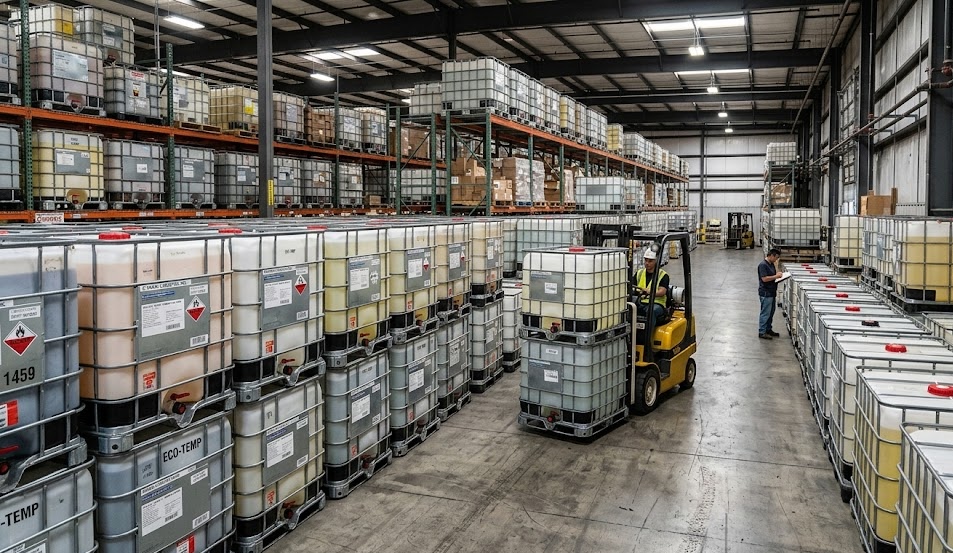
Sustainability Mission
Sustainability is not a marketing angle for us. It is the reason this company exists. Every tank we keep in circulation is a measurable win for the environment.
Get a Free Quote
Tell us what you need and we'll get back to you within 24 hours.
The Circular Economy in Action
The traditional model for IBC tanks is linear: manufacture, fill, ship, empty, discard. This model treats a sophisticated, multi-material container as disposable packaging. It is environmentally destructive and economically wasteful.
We operate on a circular model. Tanks flow through our system in loops — collected after use, inspected, cleaned, reconditioned, and sent back into service. Each loop extends the productive life of the original materials by months or years. Only when a tank is truly spent do we disassemble it for material recycling, ensuring the HDPE, steel, and wood re-enter the manufacturing supply chain.
This approach is not theoretical. It is our daily operation. Every tank on our yard is evidence of the circular economy working at a practical, commercial level. Businesses save money. Landfills receive less waste. Manufacturing demand for virgin materials drops. Carbon emissions decrease.
We believe this model should be the standard for the entire IBC industry, and we are working to make that happen — one tank at a time, one partnership at a time, across the entire Midwest.
Environmental Impact by the Numbers
These figures represent the cumulative environmental benefit of our operations. They are calculated using industry-standard lifecycle analysis methodologies and updated regularly.
IBC Tanks Diverted From Landfills
Each tank we recondition and resell represents one fewer container in a landfill. Over our history, that adds up to a mountain of material kept in productive use.
Landfill Diversion Rate
Of all tanks that enter our facility, 98% are either reconditioned for reuse or broken down for material recycling. Only contaminated, non-recoverable materials go to permitted disposal.
Metric Tons of CO2 Prevented
Manufacturing a new IBC tank generates approximately 58 kg of CO2. Reconditioning an existing one produces under 5 kg. The difference, multiplied by thousands of tanks, is significant.
Tons of Plastic Kept in Circulation
Each IBC bladder contains roughly 130 lbs of HDPE. By extending each tank's service life through multiple use cycles, we prevent massive volumes of plastic from becoming waste.
Gallons of Water Saved
Our closed-loop wash system reclaims and filters rinse water. Compared to single-pass cleaning, we use approximately 1,200 fewer gallons of fresh water per tank reconditioned.
MWh of Embodied Energy Preserved
The energy embedded in manufacturing an IBC tank — petrochemical processing, steel fabrication, assembly — is preserved every time we recondition instead of replace.
Tons of Steel Recycled
End-of-life steel cages are sent to local metal recyclers rather than landfills. The recovered steel re-enters the manufacturing supply chain, reducing demand for virgin ore mining and smelting.
Tons of Wood Chips Produced
Damaged wooden pallets that cannot be reused are chipped and provided to local mulch producers and biomass energy facilities. Nothing leaves our yard as waste if it can be reprocessed.
Year-Over-Year Environmental Improvement
Our environmental impact has grown every year as we have expanded our capacity, refined our processes, and built a larger network of supply and reuse partners.
| Year | Tanks Diverted | CO2 Prevented | Water Saved | Diversion Rate |
|---|---|---|---|---|
| 2021 | 3,200 | 56 MT | 3.8M gal | 94% |
| 2022 | 5,800 | 102 MT | 6.9M gal | 96% |
| 2023 | 8,400 | 148 MT | 10.1M gal | 97% |
| 2024 | 10,600 | 265 MT | 12.7M gal | 98% |
| 2025 (YTD) | 5,200 | 152 MT | 6.2M gal | 98% |
Detailed Carbon Offset Calculations
Every aspect of our operation contributes to carbon reduction. Here is a breakdown of where those savings come from and what they mean in real-world terms.
| Activity | kg CO2 Saved | Real-World Equivalent |
|---|---|---|
| Reconditioning (per tank) | 53 | Driving 133 miles in an average car |
| Steel cage recycling (per tank) | 38 | Powering a home for 1.5 days |
| HDPE granulation & recycling (per tank) | 24 | Planting 0.4 trees for 10 years |
| Route optimization (per delivery run) | 12 | Taking 1 car off the road for a day |
| Water reclamation (per 100 tanks) | 85 | Saving 120,000 gallons of freshwater |
| Solar energy generation (annual) | 7,800 | Offsetting 1.7 passenger vehicles per year |
CO2 equivalents calculated using EPA greenhouse gas equivalencies calculator and industry-standard lifecycle analysis data for HDPE and steel manufacturing.
Water Usage & Reclamation Data
Water stewardship is central to our operations. Our closed-loop system reclaims over 80% of all water used in the cleaning process. Here is the detailed breakdown per tank.
| Process Stage | Gallons Used | Gallons Reclaimed | Net Usage |
|---|---|---|---|
| Initial hot-water rinse | 80 | 68 (85%) | 12 |
| Caustic wash cycle | 60 | 51 (85%) | 9 |
| Final potable rinse | 60 | 48 (80%) | 12 |
| Cage cleaning | 15 | 12 (80%) | 3 |
| Facility cleanup | 5 | 0 | 5 |
| Total per tank | 220 | 179 (81%) | 41 |
Compare: a conventional single-pass cleaning operation uses 200-300 gallons per tank with zero reclamation. Our net usage of 41 gallons per tank represents an 80-86% reduction.
New vs. Reconditioned: The Real Comparison
The environmental cost of manufacturing a brand-new IBC tank is substantial. Reconditioning an existing one delivers the same functional result at a fraction of the environmental and financial cost.
| Category | New Tank | Reconditioned | Savings |
|---|---|---|---|
| CO2 Emissions | 58 kg | < 5 kg | 91% |
| Water Usage | 2,400 gal | 200 gal | 92% |
| Energy Consumed | 340 kWh | 45 kWh | 87% |
| Plastic Required | 130 lbs (new) | 0 lbs | 100% |
| Steel Required | 85 lbs (new) | 0 lbs | 100% |
| Cost to Buyer | $300-$450 | $90-$180 | 60-70% |
| Lead Time | 4-8 weeks | 1-3 days | 90%+ |
| Landfill Contribution | Full unit at EOL | < 2% by weight | 98% |
Data based on lifecycle analysis of standard 275-gallon HDPE/steel IBC tanks. Actual figures may vary based on tank condition, previous contents, and reconditioning scope.
How We Compare to Industry Averages
The IBC reconditioning industry varies widely in quality and environmental commitment. Here is how our performance compares to the national industry average.
| Metric | Omaha IBC Tanks | Industry Average |
|---|---|---|
| Landfill diversion rate | 98% | 62% |
| Water reclamation rate | 81% | 35% |
| Component recycling rate | 99% | 70% |
| Avg. tank use cycles before EOL | 5-7 | 2-3 |
| Carbon offset per tank (kg CO2) | 53+ | 20-30 |
| Renewable energy usage | 25% | < 5% |
Industry averages sourced from the International Container Reconditioning Association (ICRA) annual benchmarking reports and EPA industrial recycling data.
The Tank Lifecycle at Omaha IBC
Every tank that enters our facility follows a carefully managed process designed to maximize its useful life and minimize environmental impact at every stage.
Collection & Intake
We pick up used IBC tanks from manufacturers, distributors, and industrial operations across the Midwest. Each incoming tank is cataloged and assessed for condition, previous contents, and remaining service life.
Inspection & Grading
Every tank undergoes a thorough multi-point inspection. We evaluate the HDPE bladder for cracks, UV degradation, and chemical staining. The steel cage is checked for structural integrity, rust, and weld quality. The valve assembly and pallet base are tested independently. Tanks are graded on a transparent A/B/C scale.
Cleaning & Reconditioning
Tanks rated for reuse go through our professional reconditioning process. This includes triple-rinse cleaning with water reclamation, pressure testing, valve replacement when needed, cage straightening, and cosmetic restoration. FDA-compliant protocols are used for food-grade reconditioning.
Resale & Redeployment
Reconditioned tanks are matched to their next user based on grade and intended application. A tank that previously held food-grade liquids can continue in food service; one from chemical service is channeled to appropriate industrial uses. This matching maximizes both safety and value.
Multiple Use Cycles
A well-maintained IBC tank can serve 5 to 7 use cycles before the HDPE bladder reaches end-of-life. We encourage customers to return tanks to us after use, creating a closed loop that extracts maximum value from every container manufactured.
End-of-Life Recycling
When a tank truly cannot be reconditioned, we disassemble it for material recycling. The HDPE bladder is granulated and sold to plastics recyclers. The steel cage goes to metal scrap processors. The wooden pallet is chipped for mulch or biomass. Nothing is wasted.
Our Green Practices
Beyond the core business of tank reconditioning, we invest in operational practices that reduce our own environmental footprint.
Water Reclamation System
Our closed-loop wash system captures, filters, and reuses rinse water. Settled solids are removed and disposed of properly. This system reduces our freshwater consumption by over 80% compared to conventional single-pass cleaning.
Zero-Waste Disassembly
When tanks reach end-of-life, we separate every component for its highest-value recycling stream. HDPE goes to plastics reclaimers, steel to metal recyclers, and wood to biomass processors. Our target is 100% material recovery on every decommissioned tank.
Route Optimization
Our logistics software optimizes pickup and delivery routes to minimize fuel consumption and emissions. We combine multiple stops per trip and coordinate backhauls so trucks rarely run empty. Every mile saved is diesel not burned.
Chemical-Free Cleaning Options
For many applications, our high-pressure hot-water cleaning process eliminates the need for chemical detergents entirely. When chemicals are required, we use biodegradable, EPA-approved cleaning agents and manage all wastewater in compliance with local regulations.
Material Tracking & Reporting
We maintain detailed records on every tank — its origin, previous contents, number of use cycles, inspections performed, and eventual disposition. This traceability ensures compliance and allows us to provide environmental impact reports to customers who need sustainability documentation.
Local Sourcing Priority
We prioritize sourcing tanks from within our region to minimize transportation distances. The shorter the supply chain, the lower the carbon footprint. Most of our inventory comes from within a 200-mile radius of Omaha.
Solar Energy Investment
Our facility rooftop hosts a 48-panel solar array that generates approximately 18,000 kWh of clean electricity per year — offsetting roughly 25% of our total facility energy consumption. We plan to double this capacity within two years.
Paperless Operations
All inspection records, invoices, reconditioning certificates, and delivery documentation are managed digitally. We estimate this eliminates over 15,000 sheets of paper annually. Customers receive all documentation via email or our secure customer portal.
Local Recycling Partners
We work with a network of local and regional recycling organizations to ensure every material stream from our facility reaches its highest-value reuse destination.
Midwest Plastics Recycling Co.
Processes our granulated HDPE bladders into recycled pellets used in pipe manufacturing and agricultural products.
Omaha Steel & Metal
Accepts our decommissioned steel cages for shredding and remelting into new steel products.
Great Plains Mulch & Biomass
Chips our damaged wood pallets into mulch for landscaping and biomass fuel for regional energy production.
CleanWay Environmental
Licensed waste management provider that handles our settled cleaning residuals and non-recyclable waste streams.
Educational Outreach Programs
We believe that sustainability education is just as important as sustainable operations. Our outreach programs help spread circular economy thinking across the community.
School & University Tours
We host guided facility tours for K-12 schools, community colleges, and university programs. Students see firsthand how the circular economy works — from tank intake through reconditioning to material recycling. Over 500 students have toured our facility in the past two years.
Metropolitan Community College Internship
Our paid internship program provides MCC students in logistics, environmental science, and industrial technology with hands-on experience in industrial recycling operations. Interns rotate through every department over a 12-week program. Three former interns are now full-time employees.
Sustainability Workshops for Businesses
We offer free quarterly workshops for local businesses interested in reducing their container waste. Topics cover IBC lifecycle management, cost-benefit analysis of reuse vs. new purchase, and how to set up a container return program. Workshops are held at our facility and are open to any business.
Community Garden Partnerships
We partner with over a dozen community gardens and urban farms in the Omaha metro area, providing free reconditioned tanks for rainwater harvesting and irrigation. Our team also provides installation guidance and maintenance tips for using IBC tanks in garden settings.
Sustainability Certifications & Compliance
Our certifications and compliance records demonstrate our commitment to meeting the highest environmental and operational standards in the industry.
| Certification / Standard | Date | Status |
|---|---|---|
| EPA Waste Handling Compliance | Renewed annually | Active |
| FDA-Compliant Reconditioning (21 CFR) | Ongoing compliance | Active |
| DOT Transportation Standards | Ongoing compliance | Active |
| Nebraska DEE Operating Permit | Renewed 2024 | Active |
| IICRC Container Cleaning Standards | Certified 2023 | Active |
| ISO 14001 Environmental Management | In progress — target 2026 | Pending |
| B Corp Certification | Application submitted 2025 | Pending |
| Nebraska Green Business Certification | Awarded 2022 | Active |
Our 5-Year Sustainability Pledge
We hold ourselves accountable by publishing specific, measurable sustainability goals with target dates. Here is where we are headed and how far along we are.
Achieve 99.5% landfill diversion rate
Current
98%
Target
2027
Process 25,000 tanks annually
Current
12,000
Target
2028
Reach 50% renewable energy for facility operations
Current
25%
Target
2027
Obtain ISO 14001 Environmental Management certification
Current
In progress
Target
2026
Achieve B Corp certification
Current
Application submitted
Target
2026
Establish 3 satellite collection depots in the Midwest
Current
0
Target
2028
Implement RFID tank tracking across entire inventory
Current
Pilot phase
Target
2027
Eliminate all single-use plastics from our own operations
Current
80% eliminated
Target
2026
Partner with 100+ farms for recurring tank return program
Current
50+
Target
2029
Prevent 1,000 metric tons of cumulative CO2 emissions
Current
350+ MT
Target
2029
Partner With Us for a Greener Supply Chain
Whether you need one reconditioned tank or a recurring supply of hundreds, choosing Omaha IBC Tanks means measurable environmental benefits you can report to stakeholders. Let us help you make sustainability a competitive advantage.
Our Story
Learn how Omaha IBC Tanks was founded and our journey to becoming the Midwest's IBC hub.
Read moreWhy Choose Us
Discover the competitive advantages that set Omaha IBC Tanks apart from the competition.
Learn moreReconditioned Tanks
Browse our inventory of professionally cleaned and inspected IBC tanks ready for reuse.
View products